Top Competition Analysis Examples to Improve Your Product
There are multiple ways to go about doing a Competition Analysis when you want to use it to improve your product. However basis my experience, three effective strategies works are Feature Comparison, Analyzing User Reviews and Visual Screen Comparison

Competition Analysis is a must-have skill for Product Managers and UX Designers.
While it's best not to blindly copy the competition, it's always a good idea to track and analyse them.
Such an analysis can help you to:
There are multiple ways to go about doing a Competition Analysis. However basis my experience of doing this exercise for companies, as well as observing how others do it, I have zeroed in on 3 effective strategies:
1. Feature Comparison
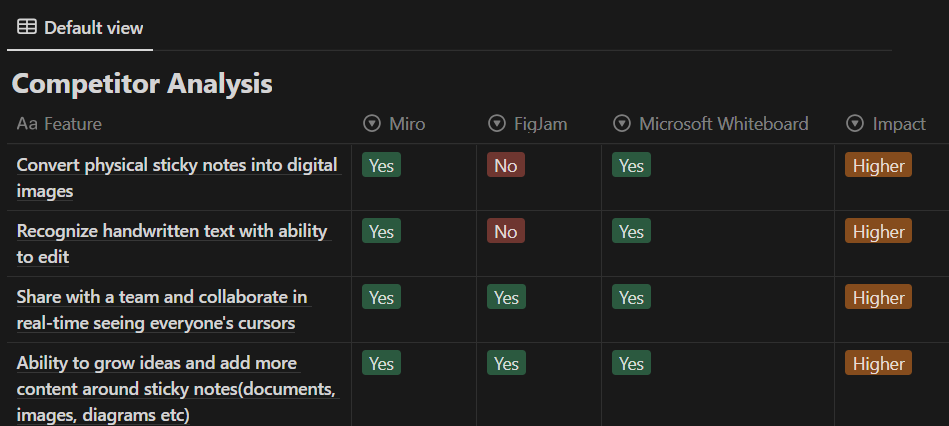
In a simple table format, just list down competitors and your product, either in one row or column and use the other axis to list feature sets.
The comparison can be of various types:
- A simple ✅ or ❌ to denote if a feature is present or not
- Use a Likert scale methodology if you want to add more depth to comparison
- Or you can just give a score out of 5 to denote the depth of feature
2. User flow/Visual screen based comparison
This approach is very effective if you want to make UX improvements to your product. Pick a key user flow like Onboarding, Checkout, etc. and document each screen in a tabular format. Then stack all screens in a column sequence.
Similarly, repeat this for your competitors' screens and stack them as well.
This will help give you a good way to compare each screen visually and identify improvements
3. Check User Reviews
In this approach, you can simply scan the user reviews listed on iOS and Google Play Store, review sites like G2 Crowd and Capterra, etc., and start collating insights from them. You may have to put the reviews in a structured format, to gather insights.
For example, are users complaining more about usability, speed, or anything else? And accordingly highlight the patterns.

At UXHack, we have done some interesting case studies around Competition Analysis for the above scenarios.
The top submissions to these case studies will give you some real-world examples of how to do a Competition Analysis.
1. Figma
In this challenge, the focus was to compare FigJam (their whiteboarding product) with two of its competitors and come up with product improvements.
The best submissions had a detailed Feature comparison with popular competitors like Miro, and also identified pain points basis what competitors' users mentioned in their public reviews.
2. Google Meet
In this challenge, the focus was to compare Google Meet with Zoom, Microsoft Teams and GoToMeeting. Basis the analysis, the participants were expected to identify the top 3 impactful tweaks they would make to Google Meet.
The best submissions in this case had a Matrix-type comparison of Google Meet with its competitors on various parameters like Features, Security, Ease of Use etc.
3. Disney + Hotstar
In this challenge, participants were asked to evaluate Hotstar's competitors to find features that Hotstar can implement/adopt. Participants were asked to identify 3 of the top features that will improve the user experience of the app, should they be adopted.
This exercise was done pre-Covid. Thus the best recommendations that were picked from competitors like Netflix and YouTube are now already available on the Disney+Hotstar app. Some of the features that came up included Multi-Device and multiple Profile recommendations.
To explore more case studies that covers other topics like UX Audit, Gamification, Ideation and more, check out 50+ case studies at uxhack.co/eldorado/
Now try it on a real brief
Enter an open UXHack challenge, get feedback from reviewers, and keep the case study for your portfolio.